Entity Property: entity properties
Attribute; Reaction states
“Substrate(s)”, “product(s)”, “intermediate(s)”, and “transition
state(s)”, which are reaction states, will be annotated in this
category. In addition, their EntityAttribute will be identified as
ReactionState. Those words, which describe the characteristics of
these reaction states, such as “covalent”, “tetrahedral”, and
“negatively-charged”, will be included in the annotation (see example
1).
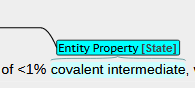
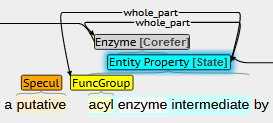
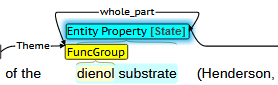
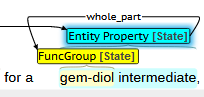
Moreover, if the functional groups or “enzyme” are indicated adjacent to these words, these functional groups or “enzyme” must be included into the reaction states. Such functional groups or “enzyme” must be connected by “whole_part” relations with the words indicating “Reaction States”, described below in the section of “Relations” (see examples 2-4).
On the other hand, if the independent “compounds” are indicated adjacent to these words, such compounds are not included in the annotation. In that case, the compounds must be connected by “correspond_to” relations with the words indicating “Reaction States”, described below in the section of “Relations” (see example 5).

Furthermore, “complexes” of enzyme structures with their corresponding ligand will be annotated in this category, with their “EntityAttribute” identified as “ReactionState”. If the enzyme and its ligand molecules are indicated along with “complex”, the “enzyme” and “ligand molecules” will be included along with “complex” in the annotation, and the relationships will be annotated with “whole_part” from “complex” to “enzyme” or “ligand”, described below in the section of “Relations” (see examples 6-7).

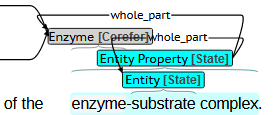
Attribute; Reactive parts
The phrases such as “leaving group”, “acceptor group”, “scissile bond” and “cleavage bond”, which generally describe reactive parts of compounds or enzyme functional groups, will be annotated in this category. Occasionally, the words “group”, “moiety” or “bond” can be abbreviated in these phrases.
Other entity properties
“Active site” and “binding site” will be annotated in this category. In addition, some “motif(s)”, “region” and “sequence”, which indicates some specific part of enzymes, will be annotated in this category.
- binding motif(s)
- signature motif(s)
- conserved (113)RTXGISTT motif
- conserved (14)HXGH motif
- analogous HXGH motifs
- histidine motif
- binding region(s)
- region(s)
- (multiple) regulatory regions
- primed region
- single-stranded regions
- Mn2 region
“Mutation” or those words that describe mutations, such as “replacement”, and “change”, will be included in this category. The emphasized words can be replaced with other phrases.
Some parameters, such as the following, will also be annotated as “entity property”.
- k(cat)
- k(cat) values
- kcat
- k(cat)/K(m)
- k(cat)/K(m) value
- kcat/KM
- kcat/Km
- log(k(cat))
- log(k(cat)/K(m))
- pKa
- pK(a)
- Ki
- Ki values